1. Why Revenue Land Records Determine Real Property Ownership in Tamil Nadu
Buying landed property in Tamil Nadu is a vital financial investment. However, plot buyers often assume that a registered sale deed alone guarantees total ownership. In Tamil Nadu, property administration operates across two independent departments: the Registration Department, which records transactions, and the Revenue Department (Department of Survey and Settlement), which maintains records of lawful ownership and tax liability.
While a sale deed confirms that a conveyance took place, only the Patta Chitta confirms that the Government of Tamil Nadu recognizes the buyer as the legal titleholder in state revenue ledgers. Banks mandate Patta Chitta to approve plot loans; planning bodies like CMDA and DTCP require it for layout sanctions, and utility providers like TNEB require it for power connections. At Elephantine, transparent documentation is the foundation of our curated plots and gated communities in Chennai. This definitive 2026 guide explains how to view, download, authenticate, and transfer your Patta Chitta online with confidence.
2. Demystifying Land Records: What is Patta Chitta, and How Does it Differ from EC & FMB?
Historically, land records in Tamil Nadu comprised separate registers kept by the local Taluk Office and Village Administrative Officer (VAO). Through state digitization, these ledgers are now integrated into an accessible digital system.
Understanding Patta vs. Chitta
- Patta (Ownership Title): Issued by the Revenue Department, the Patta records the owner’s name, survey number, subdivision, district, taluk, village, and total land area. It serves as primary administrative proof of ownership.
- Chitta (Land Classification): Maintained at the village revenue level, the Chitta specifies the classification of the parcel—such as Nanjai (wetland), Punjai (dryland), or Natham (residential village land)—and applicable tax assessments.
Today, both records are merged on the official portal into a unified Patta Chitta extract. Complete due diligence also requires reviewing other essential statutory documents.
Summary of Core Tamil Nadu Land Records
| Record Type | Primary Function | Issuing Portal / Department | When It Is Mandatory |
| Patta Chitta | Proves revenue ownership, land extent, tax status, and soil classification. | eservices.tn.gov.in (Survey Department) | Property purchases, bank mortgages, building plan approvals, utility meters. |
| FMB Sketch | Survey boundary map depicting field dimensions, angles, and adjacent survey plots. | eservices.tn.gov.in (Survey Department) | Site demarcation, layout fencing, resolving boundary disputes with neighbors. |
| TSLR Extract | Town Survey Land Register extract for municipal corporation / urban properties. | eservices.tn.gov.in (Urban Records) | City plot verification in Chennai, Coimbatore, Corporation property tax. |
| A-Register Extract | Comprehensive village register displaying historical ownership, classification, and area. | eservices.tn.gov.in (Revenue Department) | In-depth title due diligence, verifying historical land status before purchase. |
| Encumbrance Certificate (EC) | Chronicles all registered transactions, mortgages, court attachments, and legal claims. | tnreginet.gov.in (Registration Department) | Compulsory 13 to 30-year search to rule out financial encumbrances and liens. |
3. Step-by-Step Guide: How to View and Download Patta Chitta Online in 2026
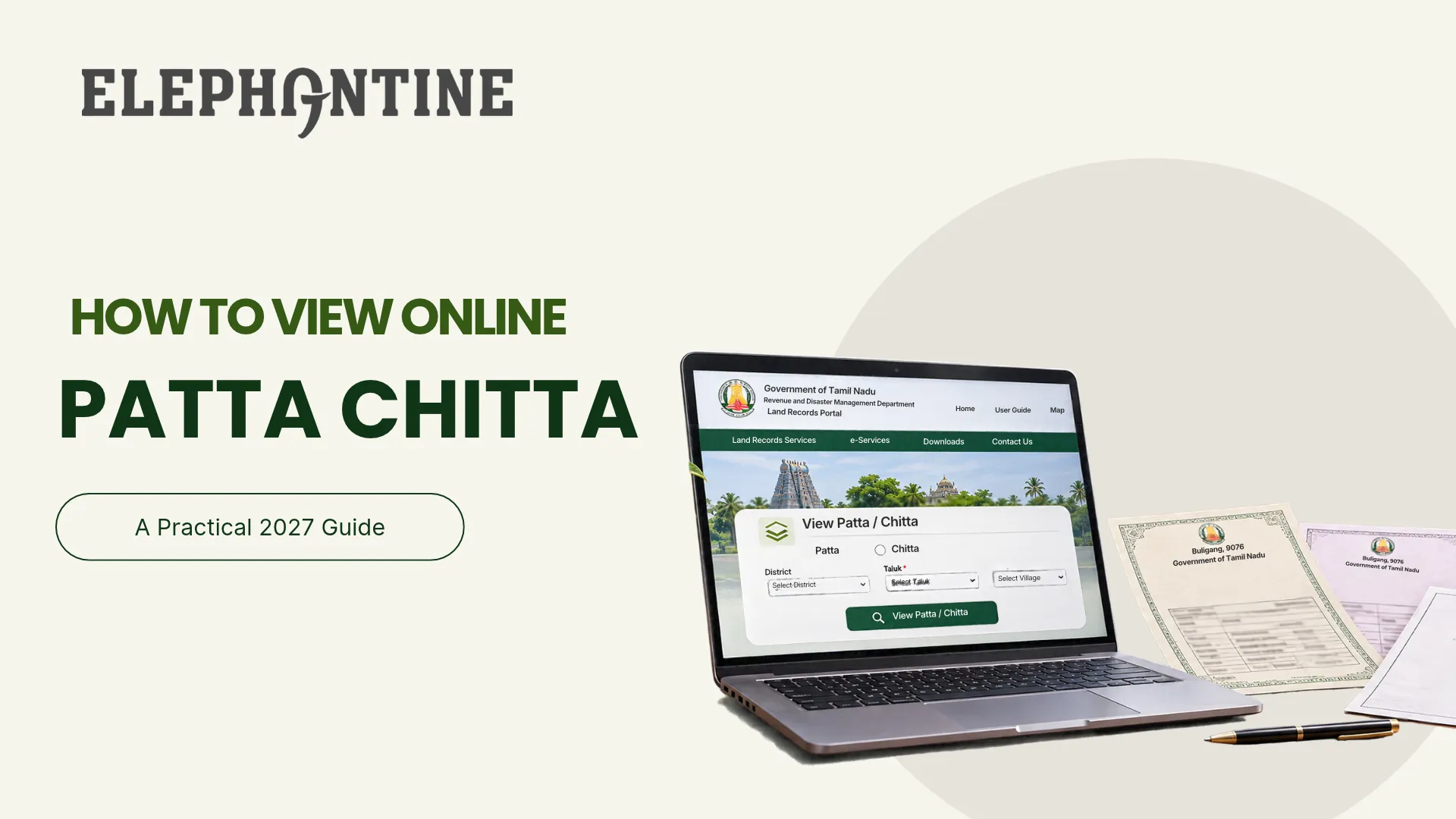
The official portal for land records in Tamil Nadu is eservices.tn.gov.in. Viewing and downloading extracts is completely free. In 2026, searches authenticate users via a 10-digit mobile number and SMS OTP.
Procedure for Rural & Natham Land (Patta / Chitta / FMB)
- 1. Access the Portal: Visit eservices.tn.gov.in and click ‘English’ in the top right header if preferred.
- 2. Select Service: Click ‘View Patta / Chitta / FMB – (Rural / Natham)’ on the homepage.
- 3. Select Administrative Details: Choose your District, Taluk, and Village from the dropdown menus.
- 4. Choose Search Method: Select ‘Patta Number’ or ‘Survey Number’. For survey numbers (e.g., 24/2A), enter ’24’ in Survey Number and ‘2A’ in Sub Division. If no subdivision exists, enter a dash (-).
- 5. Verify via Mobile OTP: Enter your 10-digit mobile number, click ‘Get OTP’, and submit the verification code.
- 6. View and Download: The digital Patta Chitta will display the owner’s name, land area, and survey details. Click ‘Print’ or ‘Save as PDF’ to download.
Urban Properties: Town Survey Land Register (TSLR)
For city properties in municipal corporations like Chennai or Coimbatore, land records follow the Town Survey system. Click ‘TSLR Extract’ on eservices.tn.gov.in, select District, Taluk, Town, Ward, and Block, and enter your Town Survey Number (T.S. No.) and Sub Division Number to view your extract.
The 2026 Integrated Land Record (ILR)
Introduced on March 4, 2026 under G.O.(Ms.) No. 613 and G.O.(Ms.) No. 142, the Integrated Land Record (ILR) merges the Record of Rights, Chitta details, and FMB sketch into one digital document featuring an embedded QR code for mobile verification.
4. Critical Verification: How to Authenticate a Patta Document Before Purchase
Never accept a paper copy or PDF of a Patta Chitta without verifying it against live revenue records. Follow these verification steps on eservices.tn.gov.in:
- Locate Reference Number: Authentic digital extracts include an official Reference Number and Authentication Value printed at the bottom.
- Open Verification Tool: Navigate to eservices.tn.gov.in and select ‘Verify Patta / Chitta – (Rural / Natham)’.
- Validate Live Data: Enter the reference number and complete mobile OTP verification. Confirm that the owner’s name, survey number, and area match the seller’s papers exactly.
- Scan Embedded QR Codes: For Integrated Land Records, scan the document’s QR code using your smartphone camera to access the official verification page directly.
Reluctance by a seller to share their reference number or allow live verification is a red flag before paying any advance deposit.
5. The Boundary Safeguard: Understanding the Field Measurement Book (FMB) Sketch
While a Patta confirms legal recognition of ownership, the Field Measurement Book (FMB) sketch illustrates the physical boundaries and exact dimensions of the parcel. Prepared by revenue surveyors, the FMB details boundary lines, subdivision partitions, and adjoining survey parcels.
- Free Official Download: FMB sketches can be downloaded at no charge under ‘FMB Sketch – (Rural / Natham)’ on eservices.tn.gov.in.
- Detecting Encroachments: Before purchasing, engage a licensed surveyor to measure the property on-site and reconcile boundary markers against the FMB diagram to identify any encroachments.
- Subdivision Accuracy: When buying a plot carved out of a larger parcel, ensure the subdivision is formally recorded in the FMB with its own assigned subdivision number.
6. The Online Patta Transfer Procedure: Timelines, Fees & Required Documents
Executing a sale deed at the Sub-Registrar’s Office (SRO) does not automatically transfer the Patta. You must formally apply for a Patta Transfer to update the revenue ledger in your name.
- Application Channels: Apply online via the Tamil Nilam Citizen Portal (tamilnilam.tn.gov.in/citizen/) with OTP verification, or submit an application at a Common Service Centre (CSC) in your taluk.
- Application Categories: Transfers are classified into ‘Not Involving Sub Division’ (NISD) for entire survey parcels, and ‘Involving Sub Division’ (ISD) for plots requiring on-site survey demarcation.
- Processing Timelines & Fees: Straightforward NISD transfers are slated for completion within 15 days, while ISD transfers take up to 30 days. The CSC fee is Rs. 60, while online portal fees range from Rs. 100 to Rs. 300.
- Mandatory Documents: Certified copy of the Registered Sale Deed, Encumbrance Certificate from TNREGINET, identity proof, previous Patta copy, and Legal Heir Certificate / NOC if inherited.
7. Land Classifications to Avoid: Understanding Nanjai, Punjai, Natham & Poramboke
Checking the land classification on your Patta Chitta ensures you avoid unbuildable or disputed parcels. The revenue department classifies real estate based on historic cultivation, water access, and designated usage:
| Land Classification | Official Revenue Meaning | Practical Implication for Land Buyers |
| Natham / Grama Natham | Historic village residential habitation area. | Exempt from agricultural land ceilings; legally designated for residential dwellings and housing development. |
| Dry Land (Punjai) | Agricultural land reliant on seasonal rainfall rather than perennial canals. | The most common land converted for residential layouts; requires formal conversion sanction from planning authorities (DTCP/CMDA). |
| Wet Land (Nanjai) | Fertile agricultural land irrigated by perennial canals, lakes, or river systems. | Subject to stringent statutory conversion curbs; requires special permissions from the District Collector and revenue authorities. |
| Urban / Nagaram | Parcels situated inside notified municipal town or city corporation borders. | Governed by urban development rules, municipal building regulations, and Town Survey Land Registers (TSLR). |
| Poramboke (CRITICAL WARNING) | Government-owned land reserved for public roads, water bodies, channels, or grazing. | CANNOT BE LEGALLY OWNED BY ANY PRIVATE PERSON. Any Patta issued on Poramboke land is completely invalid and void. The government retains the absolute right to reclaim such land at any time without compensation. |
8. The Elephantine Standard: Institutional Due Diligence for Peace of Mind
Navigating state databases—eservices.tn.gov.in for Patta Chitta and FMB, tnreginet.gov.in for Encumbrance Certificates, and local taluk offices for field maps—can be daunting for individual buyers. Overlooking an unrecorded subdivision or an unresolved mortgage can lead to prolonged disputes.
At Elephantine, we believe that real luxury is rooted in peace of mind. Every project across our residential plotted developments in Chennai undergoes thorough legal and spatial vetting. Our legal team secures complete 30-year title searches, secures full DTCP and CMDA statutory approvals, establishes individual pre-cleared Patta allocations, and demarcates every plot to match official FMB boundary records with precision.
The 7-Point Land Buyer’s Due Diligence Checklist
- 1. Digital Patta Authentication: Download an extract from eservices.tn.gov.in and verify its Reference Number or QR code online.
- 2. Comprehensive 30-Year EC: Obtain an Encumbrance Certificate from tnreginet.gov.in to confirm an unbroken chain of ownership free of mortgages.
- 3. Physical FMB Demarcation: Inspect boundary markers on-site with a licensed surveyor, cross-checking physical dimensions against the FMB sketch.
- 4. Village A-Register Validation: Check the village register extract to ensure the plot is not recorded as Poramboke or environmentally protected waterbody land.
- 5. Urban TSLR Cross-Check: For land within Chennai corporation limits, verify Ward, Block, and Town Survey numbers against municipal records.
- 6. Statutory Planning Approval: Confirm that the plotted layout has valid DTCP or CMDA sanction with clearly demarcated roads and public utility spaces.
- 7. Prompt Patta Transfer: Following deed registration, promptly file your transfer application through the Tamil Nilam portal to secure revenue ownership.
| Invest in Pre-Verified, Clear-Title Plotted Communities with Elephantine Ready to build your dream home on legally certified, premium land in Chennai? Explore our DTCP/CMDA approved developments or connect with our property legal specialists today. → Explore Elephantine Developments | → Connect with a Land Specialist |